
2. How should CBE competency achievement criteria be modeled in the database?#
Context#
Competency Based Education (CBE) requires that the LMS have the ability to track learners’ mastery of competencies through the means of competency achievement criteria. For example, in order to demonstrate that I have mastered the Multiplication competency, I need to have earned 75% or higher on Assignment 1 or Assignment 2. The association of the competency, the threshold, the assignments, and the logical OR operator together make up the competency achievement criteria. Course Authors and Platform Administrators need a way to set up these associations in Studio so that their outcomes can be calculated as learners complete their materials. This is an important prerequisite for being able to display competency progress dashboards to learners and staff to make Open edX the platform of choice for those using the CBE model.
In order to support these use cases, we need to be able to model these rules (competency achievement criteria) and their association to the tag/competency to be demonstrated and the object (course, subsection, unit, etc) or objects that are used as the means to assess competency mastery. We also need to leave flexibility for a variety of different types as well as groupings to be able to develop a variety of pathways of different combinations of objects that can be used by learners to demonstrate mastery of a competency.
Additionally, we need to be able to track each learner’s progress towards competency demonstration as they begin receiving results for their work on objects associated with the competency via competency achievement criteria.
Terminology#
To reduce ambiguity, this ADR uses the following CamelCase domain terms:
CompetencyTaxonomy: A taxonomy that is explicitly enabled for CBE competency features.CompetencyAchievementCriteria: The full criteria expression used to evaluate each learner’s status for one competency. Evaluation yields a competency outcome (at minimum demonstrated/not demonstrated, and potentially richer outcomes such as mastery level in future ADRs).CompetencyCriteriaGroup: An internal node in theCompetencyAchievementCriteriaexpression tree that combines child nodes withANDorOR.CompetencyCriterion: A leaf node in theCompetencyAchievementCriteriaexpression tree. It points to one tag/object association plus the rule used to evaluate that object.CompetencyRuleProfile: A reusable default evaluation rule that can be scoped by taxonomy, course, or organization.
In short: CompetencyAchievementCriteria is the full tree, while CompetencyCriterion is one leaf in that tree.
Decision#
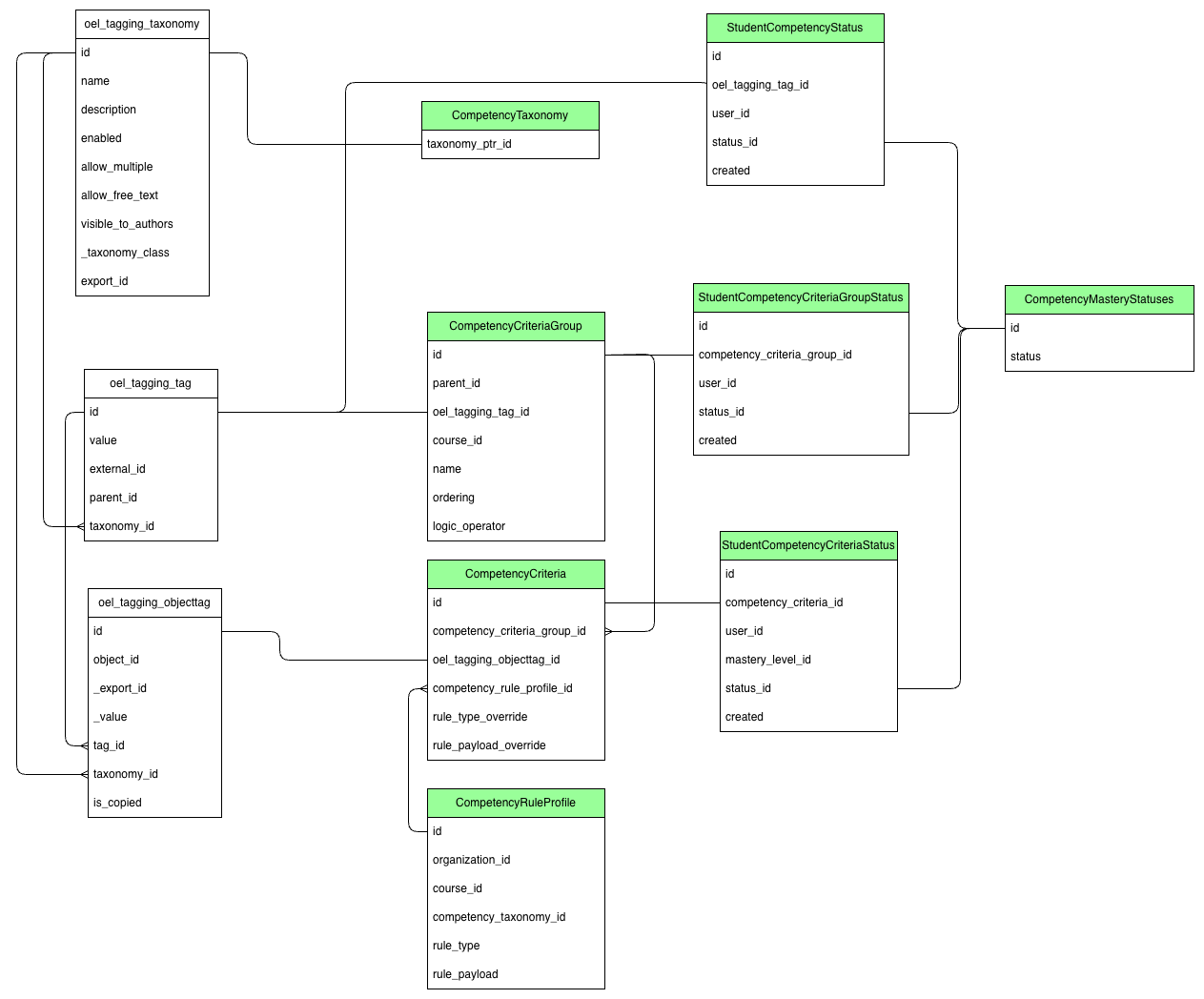
CompetencyTaxonomyconcept (database table)Represents the set of taxonomies that are competency-enabled rather than generic tag-only taxonomies.
Maps to
Taxonomyusing Django multi-table inheritance (CompetencyTaxonomy(Taxonomy)), not ataxonomy_typecolumn onoel_tagging_taxonomy.Relationship to other concepts:
CompetencyRuleProfilecan be scoped to aCompetencyTaxonomy.CompetencyCriteriaGroupandCompetencyCriterionare only valid for competencies from enabled taxonomies.
A taxonomy listed in this table:
is able to be displayed in the UI with the competency criteria association view.
is able to be displayed in the UI with the competency progress tracking views.
is also able to be displayed in existing taxonomy views.
has constraints on associated content objects to only be those supported for progress tracking.
has constraints on associated content objects to only include ones that could logically be used to demonstrate mastery of the competency (for example, associating both a course and one assignment within that same course would be ambiguous).
In contrast, a taxonomy that is not listed in this table:
is only displayed in existing taxonomy views.
is not displayed in competency criteria association views.
is not displayed in competency progress tracking views.
has no competency-specific constraints on associated content objects.
This new database table will have the following columns: 1.
taxonomy_ptr_id: Primary key and one-to-one foreign key tooel_tagging_taxonomy.id.Lifecycle rules for this parent/child pair:
Creating a competency taxonomy creates both the parent
oel_tagging_taxonomyrow and theCompetencyTaxonomyrow in one transaction.Deleting either representation is treated as deleting the competency taxonomy and removes both rows, subject to Decision 7 delete protections.
CompetencyCriteriaGroupconcept (database table)Represents an internal boolean-expression node for
CompetencyAchievementCriteria.A single
CompetencyAchievementCriteriais represented by one rootCompetencyCriteriaGroupplus all descendant groups and leafCompetencyCriterionrows.Relationship to other concepts:
A group belongs to one competency (
oel_tagging_tag_id) and optional course scope (course_id).A group can have child groups.
logic_operator(AND/OR) defines how children are combined.orderingdefines deterministic sibling evaluation sequence during group recomputation and enables short-circuit evaluation.
This new database table will have the following columns:
id: unique primary keyparent_id: TheCompetencyCriteriaGroup.idof the parent group. Null means this is a root group.oel_tagging_tag_id: Theoel_tagging_tag.idfor the competency represented by this criteria tree.course_id: Nullable foreign key toopenedx_catalog_courserun.idfor the course that scopes this criteria tree.name: stringordering: Indicates evaluation sequence number for this criteria group. This defines deterministic evaluation order for siblings during read-time evaluation and event-driven recomputation, and enables short-circuit evaluation.logic_operator: Either “AND” or “OR” or null. This determines how children are combined at a group node (“AND” or “OR”).
Example: A root group uses “OR” with two child groups.
Child group A (
ordering=1) requires “AND” across Assignment 1 and Assignment 2.Child group B (
ordering=2) requires “AND” across Final Exam and Lab Assignment 3.If group A evaluates to true, group B is not evaluated.
orderingcomplements learner-status materialization: progress is still persisted at leaf/group/root levels, andorderingonly defines child scan order when a parent recomputes after a leaf status change.
Concrete event example (materialization + ordered recompute):
Root group uses
ANDwith Group A (ordering=1) and Group B (ordering=2).Group A status is currently
AttemptedNotDemonstrated; Group B status is currentlyPartiallyAttempted; root isAttemptedNotDemonstrated.New event: learner completes one remaining leaf criterion under Group B, so that leaf row changes to
Demonstrated.Bottom-up materialization updates Group B first. Group B now becomes
Demonstrated.Recompute the root
ANDgroup inorderingsequence: Group A is evaluated first and is stillAttemptedNotDemonstrated, so root is determined immediately and Group B does not need to be checked for root recomputation.Persist changed rows only: the updated leaf row and Group B row. Root remains
AttemptedNotDemonstratedand is not rewritten.
Boundaries and intended behavior:
Empty groups: Persisted criteria definitions should not contain empty groups. Authoring flows may temporarily create empty groups while editing, but backend validation must reject them.
Mixed tree depths: Backend supports deeply nested groups. Current frontend authoring constraint is a maximum depth of 3 layers total, using zero-indexed depth (
0=root,1=course-scope group,2=leaf criteria/group).Retrieval scope: Evaluation/read paths should be windowed by course run dates, not full-history by default. For a requested date window
[window_start, window_end], include (a) all nodes wherecourse_id is null, and (b) complete subtrees for course-scoped groups whose course run overlaps the window (course_start <= window_endandcourse_end >= window_start, with nullcourse_endtreated as ongoing). Do not return partial subtrees.Practical size and growth: Total rows in
CompetencyCriteriaGroupare expected to grow over time as course runs are added; this ADR sets no global DB row cap. No max total node-count cap is required per root group. Forcourse_id is nullbranches, expected size is small (realistically <=500 nodes). Pagination is supported for authoring/list APIs.
CompetencyRuleProfileconcept (database table)Represents a reusable default rule configuration that can be applied to many
CompetencyCriterionrows.Relationship to other concepts:
Can be scoped by taxonomy, course, and/or organization.
Is referenced by
CompetencyCriterion, which may override its type/payload.
This new database table will have the following columns:
id: unique primary keyorganization_id: Theorganization_idof the organization that this competency rule profile is scoped to. Null if it is not scoped to a specific organization.course_id: Thecourse_idof the course that this competency rule profile is scoped to. Null if it is not scoped to a specific course.competency_taxonomy_id: TheCompetencyTaxonomy.taxonomy_ptr_idof the competency taxonomy that this competency rule profile is scoped to.rule_type: “View”, “Grade”, “MasteryLevel” (Only “Grade” will be supported for now)rule_payload: JSON payload keyed byrule_typeto avoid freeform strings. It is structured JSON (not arbitrary freeform data): eachrule_typedefines the allowed payload shape and required keys, and validation enforces this contract. JSON is used instead of fixed columns likeop,value, andscaleso that future rule types (for example,MasteryLevelthresholds or plugin-defined evaluators such as CEL-based rules) can add their own fields without repeated schema migrations or many nullable columns. Examples:Grade:{"op": "gte", "value": 75, "scale": "percent"}
CompetencyCriterionconcept (CompetencyCriteriadatabase table)Represents one leaf condition in a
CompetencyAchievementCriteriatree.Relationship to other concepts:
Belongs to one
CompetencyCriteriaGroup.Points to one
oel_tagging_objecttagassociation.Uses one
CompetencyRuleProfileby default, with optional per-criterion overrides.
This new database table will have the following columns:
id: unique primary keycompetency_criteria_group_id: Foreign key toCompetencyCriteriaGroup.id.oel_tagging_objecttag_id: Tag/Object Association idcompetency_rule_profile_id: Nullable FK to theCompetencyRuleProfileapplied to this criterion. If null, evaluate using fallback lookup order: taxonomy-scoped profile, then course-scoped profile, then organization-scoped profile, then system default.rule_type_override: Nullable enumerated rule type: “View”, “Grade”, “MasteryLevel” (Only “Grade” will be supported for now). When set, this overrides therule_typein the associatedCompetencyRuleProfilefor this criterion.rule_payload_override: Nullable JSON payload keyed byrule_typeto avoid freeform strings. When set, this overrides therule_payloadin the associatedCompetencyRuleProfilefor this criterion. The same typed/validated payload contract asrule_payloadapplies. Examples:Grade:{"op": "gte", "value": 75, "scale": "percent"}
Indexes for common lookups
CompetencyCriteriaGroup(oel_tagging_tag_id, course_id)CompetencyCriteriaGroup(parent_id)oel_tagging_objecttag(object_id)CompetencyCriteria(oel_tagging_objecttag_id)CompetencyCriteria(competency_criteria_group_id)StudentCompetencyCriteriaStatus(user_id, competency_criteria_id)StudentCompetencyCriteriaGroupStatus(user_id, competency_criteria_group_id)StudentCompetencyStatus(user_id, oel_tagging_tag_id)CompetencyRuleProfile(competency_taxonomy_id, course_id, organization_id)CompetencyMasteryStatuses(status)(unique)
Learner progress status concepts (
StudentCompetency*Statusdatabase tables)When a completion event (graded, completed, mastered, etc.) occurs for an object, determine and track the learner’s status in earning the competency. To reduce recalculation frequency, store results at each level.
Relationship to other concepts:
StudentCompetencyCriteriaStatustracks status atCompetencyCriterionleaf level.StudentCompetencyCriteriaGroupStatustracks status atCompetencyCriteriaGroupnode level.StudentCompetencyStatustracks top-level competency demonstration state.All learner status rows use a shared lookup table (
CompetencyMasteryStatuses) so status semantics live in one place and student status tables stay structurally consistent.
Intended update flow (bottom-up materialization):
A learner event updates one
StudentCompetencyCriteriaStatusrow.Recompute ancestor
CompetencyCriteriaGroupstatuses upward to the root.At each group, evaluate children in
orderingsequence and short-circuit when the group’s result is already determined by itslogic_operator.Persist only rows whose status changed.
Add new database table for
CompetencyMasteryStatuseswith these columns:id: unique primary keystatus: unique status value (seeded values: “Demonstrated”, “AttemptedNotDemonstrated”, and “PartiallyAttempted”)
Notes:
This table is system-owned lookup data and should be treated as immutable configuration, not user-authored rows.
Add new database table for
StudentCompetencyCriteriaStatuswith these columns:id: unique primary keycompetency_criteria_id: Foreign key toCompetencyCriterion.iduser_id: Foreign key pointing to user_id (presumably the learner’s id, although it appears that it is possible for staff to get grades as well) inauth_usertablestatus_id: Foreign key toCompetencyMasteryStatuses.idcreated: The timestamp at which the student’s criterion status was set.
Add a new database table for
StudentCompetencyCriteriaGroupStatuswith these columns:id: unique primary keycompetency_criteria_group_id: Foreign key toCompetencyCriteriaGroup.iduser_id: Foreign key pointing to user_id (presumably the learner’s id, although it appears that it is possible for staff to get grades as well) inauth_usertablestatus_id: Foreign key toCompetencyMasteryStatuses.idcreated: The timestamp at which the student’s criteria-group status was set.
Add a new database table for
StudentCompetencyStatuswith these columns:id: unique primary keyoel_tagging_tag_id: Foreign key pointing to Tag iduser_id: Foreign key pointing to user_id (presumably the learner’s id, although it appears that it is possible for staff to get grades as well) inauth_usertablestatus_id: Foreign key toCompetencyMasteryStatuses.id. This table should have a constraint to only allow status values of “Demonstrated” and “PartiallyAttempted” since it represents overall competency demonstration state, not in-progress states.created: The timestamp at which the student’s competency status was set.
Delete protection boundaries
If no learner status rows exist for a competency definition, hard delete is allowed and cascades through competency metadata tables.
Once any related learner status exists in
StudentCompetencyStatus,StudentCompetencyCriteriaGroupStatus, orStudentCompetencyCriteriaStatus, deletion of associated competency definition rows is blocked.This delete protection applies to
oel_tagging_taxonomy,CompetencyTaxonomy,oel_tagging_tag,oel_tagging_objecttag,CompetencyCriteriaGroup,CompetencyCriteria, andCompetencyRuleProfile.Once any related learner status exists, retiring definitions may be archive-only (hidden from authoring and new associations), not hard delete.
Example#
The following example illustrates how the decision model supports both defaults and overrides without requiring authors to specify every rule by hand.
Competency: “Writing Poetry” (a competency taxonomy tag)
Course: “Course X”
Content objects:
Assignment 7: “Submit a Poem”
Assignment 9: “Remix a Poem”
oel_tagging_objecttag:Assignment 7 tagged with “Writing Poetry”
Assignment 9 tagged with “Writing Poetry”
CompetencyRuleProfile:Course-scoped default:
Grade >= 75%for this competency taxonomy
CompetencyCriteriaGroup:Root group uses
ORGroup A (
ordering=1) usesANDGroup B (
ordering=2) usesAND
CompetencyCriteria:Group A + Assignment 7 (uses default rule profile)
Group A + Assignment 9 (override to
Grade >= 85%)Group B + Assignment 7 (uses default rule profile)
Group B + Assignment 9 (uses default rule profile)
This allows authors to set a single default rule for most tagged content, and only override where needed. It also lets the same tag/object association participate in multiple criteria groups without duplicating tagging rows.
Rejected Alternatives#
Update
oel_tagging_taxonomyto have a new column fortaxonomy_typewhere the value could be “Competency” or “Tag”.Pros
Simpler model with fewer tables
Reuses existing taxonomy table and keeps reads straightforward when checking taxonomy usage
Avoids introducing an additional join for queries that only need to know whether a taxonomy is competency-enabled
Cons
Couples CBE concerns directly into the generic tagging domain model, reducing separation of concerns
Makes
oel_tagging_taxonomyless generic and encourages enum/flag growth as new specialized usages are addedPrevents strong foreign key guarantees for CBE tables, since they can only point to
oel_tagging_taxonomyand not specifically to competency-enabled taxonomiesMakes it harder to keep competency features optional for deployments that only want generic tagging
Increases risk of future refactor/migration work if the competency domain later needs to be split from tagging
Same as above except combine the
CompetencyCriteriaandoel_tagging_objecttagtables by adding the rule information as columns on theoel_tagging_objecttagtable. This would be a more denormalized approach that would reduce the number of joins needed to retrieve competency achievement criteria information but would add complexity to theoel_tagging_objecttagtable and make it less flexible for other uses.Pros
Reduces number of joins needed to retrieve competency achievement criteria information
Single-row lookup per object tag when the competency criteria is a 1:1 mapping to a tag/object association
Potentially simpler UI/API if all consumers already pivot around
objecttagand do not need criteria grouping
Cons
Dilutes semantics as
objecttagstops being a pure generic tagging junction.Many nullable columns. Most tags won’t be criteria; you’ll add mostly-null fields unless they’re scoped with a type discriminator and partial indexes.
It becomes easy to create criteria rows missing required fields (rule profile, overrides) unless enforced with a discriminator and additional constraints.
It breaks or complicates criteria grouping because a single
objecttagmay need to participate in multiple criteria groups. You would need to duplicateobjecttagrows or add another join table, which defeats the intended simplification.Down the road, permissioning differences in who can create/edit criteria vs who can create/edit generic tags would be harder to implement and audit.
Performance risk if the objecttag table becomes very large and is queried for both generic tagging and competency criteria use cases with mostly-null criteria fields.
Future rule types may require different fields, further bloating
objecttagand reducing performance for non-competency use cases.
Add a generic oel_tagging_objecttag_metadata table to attempt to assist with pluggable metadata concept. This table would have foreign keys to each metadata table, currently only competency_criteria_group and competency_criteria as well as a type field to indicate what metadata table is being pointed to.
Pros
Centrally organizes metadata associations in one place
Cons
Adds additional overhead to retrieve specific metadata
Split rule storage into per-type tables (for example,
competency_criteria_grade_ruleandcompetency_criteria_mastery_rule) instead of a single JSON payload.Pros
Provides stricter schemas and validation per rule type
Cons
Increases table count and join complexity as new rule types are added